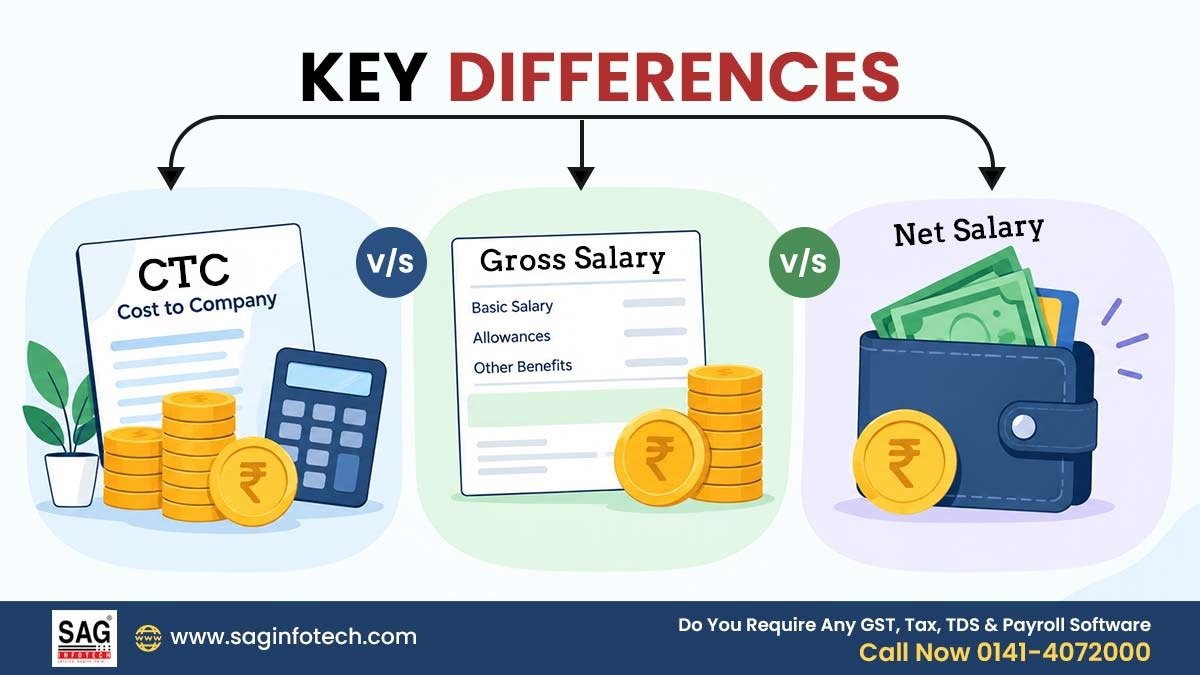
Terms like gross salary, net salary, and CTC are crucial for businesses. It influences operations and determine how your team perceives their earnings and benefits.
You can develop transparent and attractive salary packages by learning about these different types of employee compensation. The blog compares CTC vs gross salary vs net salary, and furnishes the information you must know about salary structures.
What is Cost to Company (CTC)?
It shows the entire compensation package that an employer offers to an employee. It comprises the basic salary, allowances, bonuses, benefits, and other forms of remuneration.
CTC is often specified in job postings and offer letters to specify the total compensation an employee shall receive for their work. CTC is different from the salary your employees take home, as CTC includes taxes and statutory deductions that are applied to the earnings of the employees.
Gross Salary vs CTC: What’s the Difference?
Gross salary refers to the salary that an employee earns prior to any deductions or taxes. It comprises basic salary, house rent allowance, any other allowances, and bonuses. The formula for gross salary is-
Gross salary = Basic salary + House Rent Allowance (HRA) + Other allowances + Other earnings
The gross salary is different from CTC. The table below shows the difference between CTC and gross salary-
| Factors | Cost to Company (CTC) | Gross salary |
|---|---|---|
| Definition | Complete expense incurred by the employer for an employee | Complete wages before any tax deductions are made |
| Objective | Used to define the employer’s costs and financial planning | Used to define the employee’s earnings tax responsibility |
| Features included | Basic salary, fixed allowances, variable allowances, other perquisites such as meal coupons, and employer’s assistance to PF | Basic salary, HRA and other allowances |
| Payment value | Normally higher than gross salary | Smaller than CTC and higher than take-home salary |
| Change | It can vary based on performance, as it contains incentives and bonuses | A set amount that stays stable unless the employee’s salary is revised |
Net Salary vs Gross Salary: Key Differences
Net salary is the final amount an individual obtains after all deductions have been subtracted. It can be calculated with the formula:
Net salary = Gross salary – (EPF + Income Tax + Professional Tax + Gratuity)
The difference between gross salary and net salary arises from deductions made from the gross salary, such as Employee Provident Fund, gratuity, professional tax, and income tax. The net salary might be nearly equivalent to the gross salary in cases where the income tax is minimal, or the employee’s earnings are less than the taxable income slab.
The table specifies the distinctions between gross salary and net salary.
| Factors | Gross salary | Net salary |
|---|---|---|
| Description | Total gains an employee makes, including advantages and allowances before deductions | The take-home salary part of an employee after deducting insurance, PF and more |
| Components | Contains basic salary, HRA, conveyance allowance, medical allowance and other allowances | Contains basic salary, HRA and other allowances after tax deductions like income tax, PF, and professional tax are included |
| Payment value | Describes the maximum salary payment before any tax deductions | Usually lower than gross salary due to tax deductions |
| Method of tax calculation | Computed by adding all wages | Computed by subtracting all types of tax deductions from the total wages |
| Important Formula | Gross Salary = Basic salary + HRA + other allowances | Net Salary = Gross salary – (income tax + EPF + professional tax) |
CTC Vs Gross Salary Vs Net Salary: A Comparative Overview
The below-mentioned table provides you with a comparison of CTC vs gross salary vs net salary-
| Factors | Gross salary | Net salary | CTC |
|---|---|---|---|
| Description | Total salary amount before using any tax deductions | Actual take-home salary after completing all the required tax deductions | General cost a company incurs for a worker, including salary, advantages, allowances, contributions and taxes. |
| Details | Consists of basic salary, allowances, benefits, incentives, bonuses and assistance | Contains post-tax deduction amounts of basic salary, allowances, incentives, benefits, bonuses | Incorporates basic salary, benefits, allowances, incentives, statutory contributions, bonuses and taxes |
How are Gross and Net Salary Calculated From CTC?
If you precisely determine all elements, then calculating CTC, gross salary, and net salary is easy.
From an example, understand the differences in the calculations of CTC, gross salary, and net salary. Let us consider that you offer the following compensation package for a newly hired employee at your company:
| Salary Details | Annual Payment (in INR) |
|---|---|
| Basic salary | 6,00,000 |
| CTC | 10,00,000 |
| HRA | 2,00,000 |
| Medical allowance | 50,000 |
| Conveyance allowance | 60,000 |
| Provident Fund (employee’s contribution) | 72,000 |
| Perquisites (such as meal coupons) | 18,000 |
| Provident Fund (employer contribution) | 72,000 |
The CTC of the employee is the sum of all direct benefits, totalling Rs 10,00,000.
Gross salary can be calculated by subtracting perquisites and employer’s PF contribution from CTC.
Gross salary = ₹10,00,000 – (₹18,000 + ₹72,000)
Gross salary = ₹9,10,000
Subsequently, to determine the net salary, consider that the employee pays an annual income tax of Rs 15,000.
Net salary = Gross salary – (Income tax + Employee’s PF contributions)
Net salary = ₹9,10,000 – (15,000 + 72,000)
Net salary = ₹8,23,000
Conclusion: Employers, upon learning the difference between CTC, gross salary, and net salary, gain clarity regarding their investment in employees and can budget accordingly.
With Gen Payroll Software, employers can support them in calculating gross salary, net salary, and CTC amounts for employees separately. This helps reduce the time spent calculating employee salaries from CTC by automating the process, helping employers stay compliant and work efficiently.